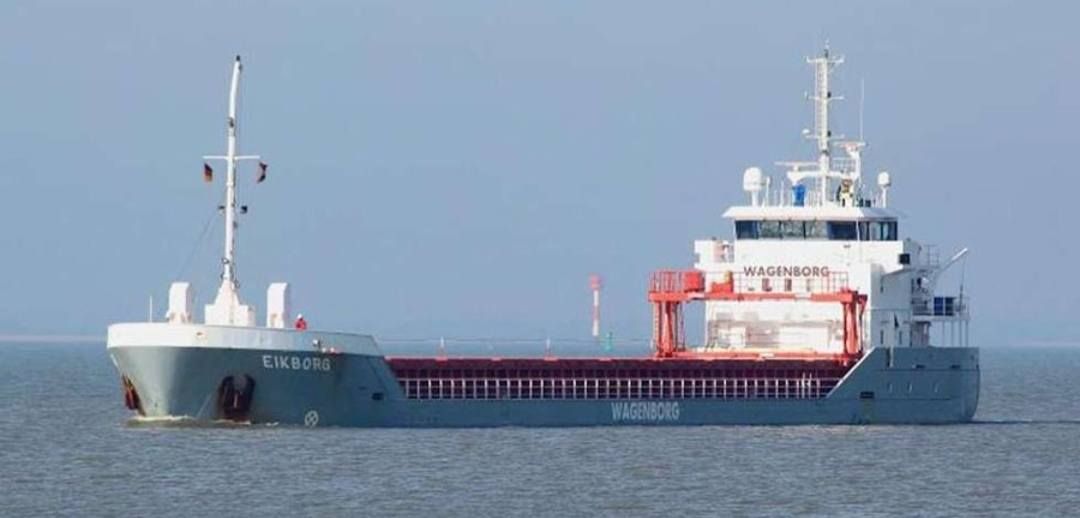
The Eikborg is an 89-meter general cargo ship flying a Dutch flag and owned by Royal Wagenborg. At the time of the accident, the ship was carrying 3,300 tons of paper pulp to Germany, with six crew members on board (Filipino, Dutch, two Indonesian, Latvian, and Russian nationals). The ship’s dead weight tonnage is approximately 3,592 tons, and the vessel is painted in the green and red colors of Wagenborg.
Incident Overview
On 26 January 2026, the Eikborg hit bottom and lost her rudder as she left the Port of Figueira da Foz, which is located on the central coast of Portugal. Shortly after leaving the bar, according to the port authorities, “the ship grounded when exiting the channel because of sediment accumulation on a sandbank.” Minutes later, the crew reported a loss of rudder control. At this point, the 89m ship was drifting 22nm (approximately 40km) southwest of the port entrance.
Location and Conditions
The grounding took place at the entrance to the Figueira da Foz harbor on the night of 26 January. Weather forecasts and authorities described “a storm of storms” with very rough seas and strong winds at the time. The ship was drifting off the coast of central Portugal after the accident. The ocean patrol ship N.R.P. Figueira da Foz of the Portuguese Maritime Authority was present at the scene, monitoring the situation. According to Portuguese sources, the ship was adrift and “navigating in reverse to stay afloat.”
Cause Analysis
Initial reports suggest that the Eikborg struck a sand accumulation (“sandbar”) in the channel. The port administration and leaders of the port community have explained that the accident is the result of incomplete or unsuccessful dredging work at the entrance of the bar. In public statements, the port community indicated that the sand accumulation was unusually serious and that a recent €28 million, 3 million m³ sand transfer project was to blame for disturbing sediment flow. However, the Portuguese Environment Agency (APA) emphasized that no conclusive explanation had yet been found. According to the APA, any connection between the grounding and dredging or harbor works was “absolutely untimely” and could not be supported. In conclusion, the most probable explanation is a grounding on a shoal at the harbor entrance, although investigations were still underway. There was no reported mechanical failure on board – the loss of the rudder seems to have been a consequence of the grounding.
Vessel Damage and Operability
The immediate consequence was a catastrophic loss of steering. With the rudder jammed or destroyed, Eikborg was “without commands, without rudder and adrift” off the bar. The crew handled the situation by reversing the engines to keep the ship head-to-sea, but this was a “counterproductive” move. The port community warned that the ship was in grave danger of sinking if water entered the engine room – the vice-president of the port community warned “we are on the verge, and I am not exaggerating, of a tragedy” if flooding began. There have been no reported injuries or pollution. The bar (channel) at Figueira da Foz was immediately declared unsafe, and all traffic of large vessels was stopped. Local pilots refused to guide any vessels in or out until surveys were conducted, effectively closing the port to shipping.
Emergency Response
The emergency effort was focused on towing Eikborg to safety. As no tug was available in the area, a Norwegian ocean-going tug was chartered by the Portuguese authorities. The owner of the vessel and the cargo interests chartered the tug on Monday night (Jan 26). By the late hours of 26 January, the tug had steamed to the location; according to official reports, it was alongside Eikborg by about 11:00 PM that night. The towlines were connected, and the Eikborg was taken under tow in very rough weather. All Portuguese ports had reportedly refused to accept the disabled vessel under tow, and the escort headed for Spain. A spokesman for the Portuguese Maritime Authority, Ricardo Sá Granja, confirmed that “the towline has already been established … and the ship is now heading for the port of Vigo” in Galicia. The tow operation was termed “extremely complicated” due to the heavy seas, with costs estimated at ~€350,000 per day (to be borne by the ship owner Royal Wagenborg and cargo owner Altri). A Portuguese Navy patrol vessel was also present at the location to assist, and authorities “continue to monitor and support” the rudderless vessel as it is towed.
Current Status
As of the latest reports (29-30 Jan 2026), Eikborg is being towed towards the Port of Vigo in Spain. The towing operation has been in progress since the night of 26-27 January, and the ship is likely to dock at Vigo on the morning of 30 January. She will then be subjected to a hull inspection and repairs at Vigo. There are no signs of Eikborg returning to Figueira da Foz immediately. On the other hand, the harbor at Figueira da Foz is closed to large vessels until dredging and inspections are completed to ensure safe passage. Already, some vessels have diverted to other ports due to the closure.
Official Statements
There have been public updates from Portuguese authorities and industry sources. The Port Community vice-president (Paulo Mariano) gave many details: he confirmed the loss of the rudder after grounding and criticized the sandbar condition. He explained the emergency towing plan, including the rerouting to Spain. The national maritime authority (AMN) also made statements: spokesman Ricardo Sá Granja confirmed the towline and Vigo destination. The Portuguese Navy and AMN together stated they “continue to monitor and support” Eikborg during tow. In a separate statement, the APA (environment agency) released a note denying dredging allegations: they stated that the sediment accumulation is a natural, cyclic winter process and that no causal link to the grounding has been found. There was no official report from the ship’s operator (Royal Wagenborg) released to the press, but the agent (Eurofoz) confirmed delays because of logistics of towing equipment and materials.
In conclusion, the case is still under investigation. Preliminary evidence suggests that the grounding was on a sandbar, followed by rudder damage, and made worse by adverse weather conditions. The Eikborg has been towed to Vigo for repairs and there have been no reported casualties. The Portuguese authorities have closed the channel affected by the incident pending dredging.
Track M/V EIKBORG Vessel on Voyage Radar: https://aisvesseltracker.com/?mmsi=244557000