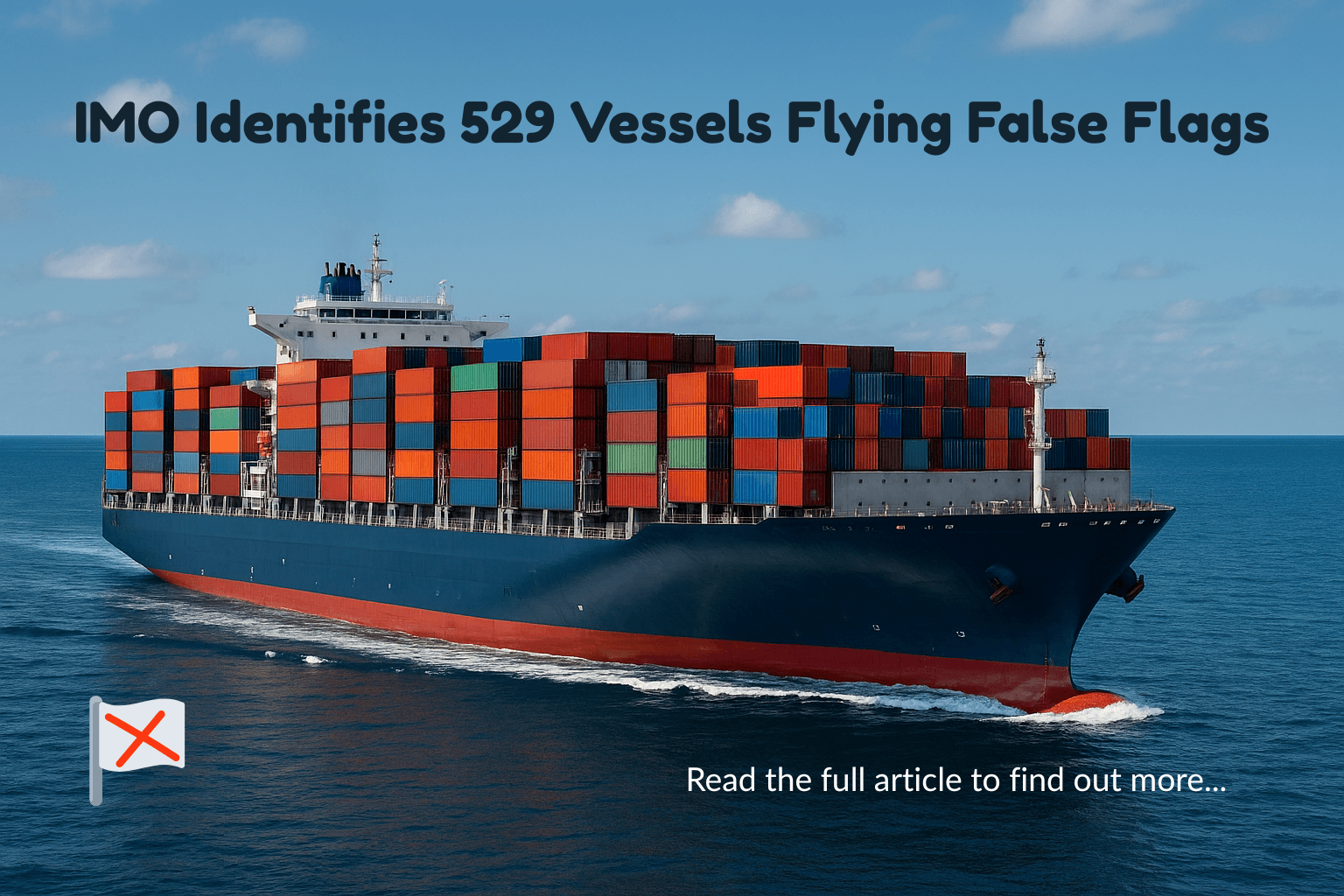
In February 2026 the International Maritime Organization (IMO) revealed that 529 ships had been flagged in its database as flying "false flags". In shipping, a false-flag vessel is one that claims a national registry it is not legally registered with – for example, broadcasting the flag and identifiers of a country that never issued its documentation. This tactic allows a ship to appear as if it belongs to a compliant flag state, even though that state does not recognize the vessel under its registry. As one analysis notes, when a ship is identified as using a flag without authorization, IMO's system marks its status as "false flag," which can only be cleared if it later properly registers with a legitimate authority.
What Is a False-Flag Vessel?
False-flagging is a form of registry fraud that has long been a concern in maritime law. IMO guidance explains that fraudulent registration occurs when a ship flies a flag "without the knowledge or approval of the relevant national maritime administration". In practice, shipowners or operators may continue to fly a flag after official registration has lapsed ("terminated registry"), submit counterfeit paperwork to IMO or authorities, or even create fake maritime administration websites to issue bogus certificates. For example, fraudsters might clone an official registry site and offer phony documents to unsuspecting owners. Ships have even been known to manipulate their AIS broadcasts – transmitting another country's MMSI number or spoofed location data – in order to pretend to be properly registered abroad. In effect, a false-flag vessel presents a forged identity on paper (and in AIS), even though it has no legitimate link to the claimed country. As Windward's maritime intelligence explains, a false flag "occurs when a vessel claims registration with a flag state that never issued, has revoked, or does not recognize that registration". This lets operators move ships without a valid flag-state oversight – often to evade sanctions, inspections, or accountability.
In fact, IMO research has shown that this is not just the theoretical possibility that it might seem to be. For instance, the IMO gives the example of the Democratic Republic of Congo (DRC), where in 2017 the country reported that 73 vessels had been operating under false flag, often in order to engage in illegal fishing in the waters of the DRC. This is now no longer just a problem in the DRC, but rather one that is affecting the world at large, as evidenced by the new figure of 529 vessels.
IMO's 529-Vessel Tally: Key Findings
According to an IMO secretariat note circulated in early 2026, the number of ships flagged as false-flag has been rising steadily. The list compiled in the IMO's GISIS database with verification support from S&P Global - breaks down 529 vessels by purported flag state and ship type. Of these, 356 ships (about two-thirds) are not covered by any recognized classification society, meaning they have no valid class certificate. This lack of classification is a major red flag to charterers and insurers, since class societies normally attest to a vessel's seaworthiness. The report notes that the falsely-flagged fleet includes all major vessel types - tankers, bulk carriers, containerships and smaller cargo vessels - and spans cases worldwide. For context, IMO emphasizes that "false flag" status can change if a ship later registers properly. But in the meantime, any vessel marked this way is effectively in limbo: its stated nationality cannot be confirmed.
This is also reflected in IMO's documentation, which reveals that this fraud is happening across all continents. A world map of reported fraud reveals that this is happening in Africa, Europe, the Caribbean, and the Pacific. In fact, this data is to be presented to its Legal Committee (April 2026), recommending new initiatives to strengthen verification of registry claims. As one source describes, "The operational consequence of this false-flag fraud explosion is that verifiers need to stop relying on paperwork and instead need to prove each and every registry claim. When a ship's flag is questionable, there are "more 'prove it' cycles between fixture, nomination, and arrival," with higher risk that a vessel will be detained or refused entry if the flag cannot be verified.
Notable False-Flag Cases by Country
Governments have reported dozens of specific fraud cases. Some illustrative examples from the IMO data include:
- Sint Maarten (Netherlands): Dutch authorities discovered two fake registry websites claiming to issue Sint Maarten certificates. They confirmed 17 vessels that were falsely flying the Sint Maarten flag on phony paperwork.
- Malawi: Landlocked Malawi (which does not operate an international shipping registry) uncovered a bogus "Malawi Ship Registry" fraud scheme. After notifying INTERPOL and investigating, Malawi found its list of suspect ships drop from 27 to 8 as bogus flags were weeded out.
- Comoros: The Comoros authorities reported multiple fraudulent websites and forged certificates relating to their flag. After verification, 83 ships remain recorded as falsely claiming Comoros registry. (At one point the count had been 131, but many vessels later reflagged or were taken out of service).
- Tonga: Tonga had a brief international ship registry until 2002, then closed it. Nonetheless, 13 tankers were identified as using the Tongan flag illegally (since Tonga declared them effectively stateless under international law).
- Caribbean and Others: Other flags with high counts include Guyana (74 ships), Aruba (35), and Curaçao (32). These figures highlight how small or open registries can be exploited. (For comparison, back in 2017 the DR's case involved 73 vessels - the current Guyana total alone exceeds that.)
In addition, countries like Benin and The Gambia reported large cleanses of their registries. Benin initially found 33 ships using a fake Benin administration site (later trimmed to 13 after checks). The Gambia removed 72 ships once forged paperwork was exposed. Some nations with no registry at all, like Lesotho, Timor-Leste, Botswana and Mali, reported that 17 vessels each were broadcasting their MMSI codes or registry details illegitimately. In the United Kingdom's case, the UK noted vessels misusing Bermuda MMSI numbers to pose as British-flagged fishing boats - an obvious breach of the true Bermuda registry rules.
Impacts on Shipping and Enforcement
The rise of false-flag vessels poses serious legal and safety risks. IMO experts warn that fraudulent registrations sever the legal link between ship and flag state. "False-flagging is a jurisdiction break: it undermines who has legal authority for safety oversight, casualty response, and enforcement," one analysis explains. In other words, if a vessel neither belongs to its claimed flag nor to any other state, then no one has clear authority to inspect it or address an incident. This creates a dangerous blind spot: a falsely-flagged ship may not carry valid insurance or class certificates, and if it causes a pollution spill or collision, liability and clean-up become much harder to enforce.
Even from a routine shipping perspective, counterparty risk skyrockets. As ShipUniverse notes, the high share of unclassified ships among the 529 means that banks, charterers, P&I clubs and port authorities can no longer rely on a vessel's paperwork alone. Underwriters have warned that a ship without a legitimate flag often has invalid insurance and classification. Traders and terminals must now verify registry claims independently: cross-check IMO numbers, contact the flagged registry through official channels, and sometimes demand extra inspections. As one expert put it, without an authorized flag many ships "operate without nationality, insurance or oversight," continuing to trade in a gray area.
The IMO has already begun addressing the problem. Its Secretariat has circulated reports on each case to member states, and the upcoming 113th Legal Committee session (April 2026) will make fraudulent registry a key agenda item. The IMO is pushing for new rules: according to the report, the secretariat "will ask the legal committee for further measures to prevent unlawful practices and to tighten verification" of registries. In parallel, industry bodies are increasing scrutiny. Port State Control regimes are being alerted to watch for identity inconsistencies, and vetting organizations are updating their "blacklists" of dubious registries.
Looking beyond IMO, experts stress that the root problem lies in transparency. Many false-flag cases involve "cloned websites, official-looking PDFs [and] fast flag-hopping," as one summary puts it. Tackling them requires shared databases and better verification tools. The IMO has encouraged digital ship ID schemes (like mandatory IMO numbers and company numbers) to help, and in 2025 it formed a working group to draft new guidelines on ship registration. Meanwhile, charterers and insurers are increasingly relying on third-party intelligence services that cross-check AIS and registry data. By flagging discrepancies - such as a vessel broadcasting a country code that was officially discontinued - these tools can catch some fraud before arrival.
Conclusion
The IMO's report of 529 vessels flying false flags is the wake-up call that the maritime authorities and the industry as a whole have been waiting for. It is an unprecedented situation where the problem of false flags has reached epidemic proportions, moving beyond the initial instances of such practices, such as the 73 vessels in the DRC, to become an international phenomenon. It is now affecting every step of the maritime journey, from document authentication to port state enforcement. However, the flip side is that the false flag phenomenon is threatening the very basis of maritime law and safety, as vessels become, in effect, 'stateless.' On the positive side, the issue is now officially 'on the table' at the UN, and the heightened awareness is ensuring greater scrutiny in the bid to close the loopholes in the registries and establish the legitimacy of the flag states.