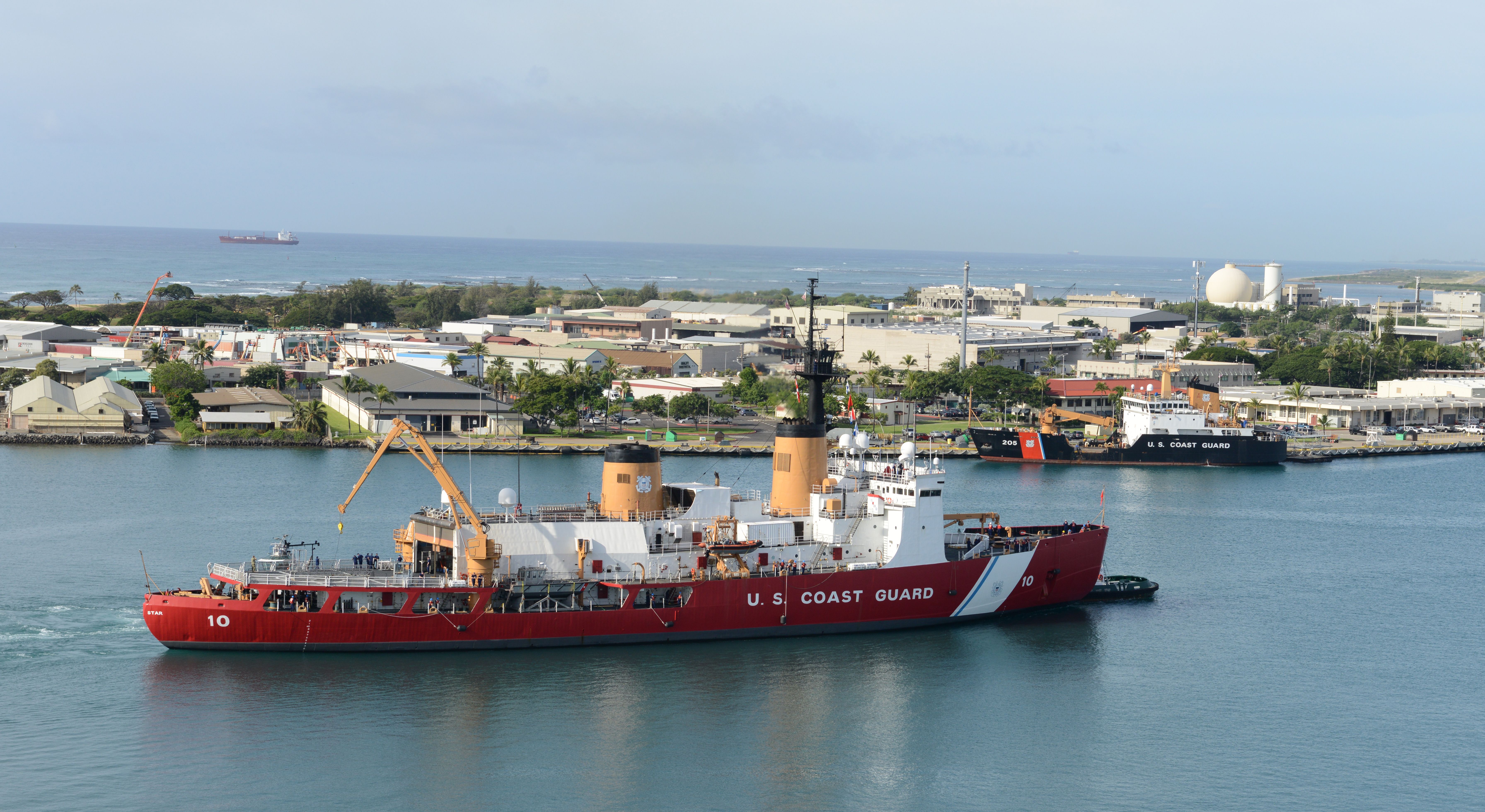
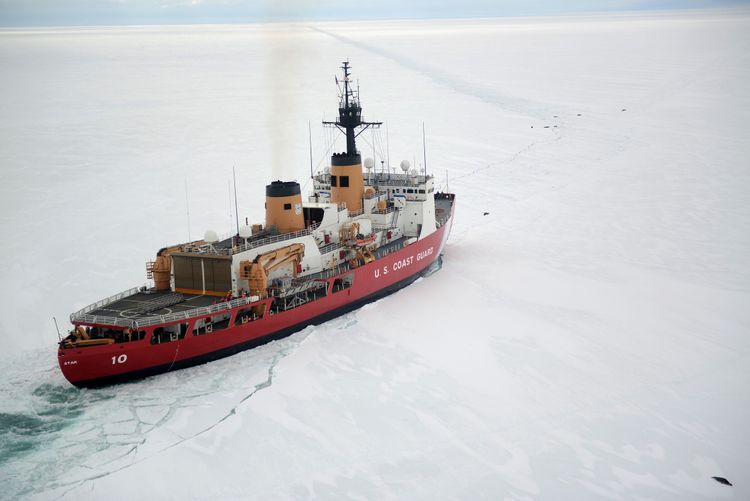
In early 2026 the U.S. Coast Guard’s heavy icebreaker Polar Star (WAGB-10) celebrated its 50th anniversary and remarkably it is still doing what it does best. Commissioned on Jan. 17, 1976, and homeported in Seattle, this 399-foot, 13,500-ton cutter is now one of the oldest ships in U.S. military service. Yet in its decades of Arctic and Antarctic duty Polar Star has earned a reputation as “the world’s most powerful non-nuclear icebreaker”. Its three aviation gas turbines and six diesel-electric generators deliver over 75,000 horsepower, enabling it to carve through sea ice and continuously break roughly 6½ feet at 3 knots (and by backing-and-ramming can penetrate up to 21 feet of ridged ice). In January 2026 the 50-year-old cutter steamed into McMurdo Sound, Antarctica, to once again open a channel for fuel and supply ships “the annual breakout” of Operation Deep Freeze. As her skipper noted, “she’s an old ship, but she’s a good ship”, and her seasoned crew has risen admirably to each year’s challenges.
Design and Capabilities
Polar Star was built by Lockheed Shipbuilding (Seattle) alongside her sister ship Polar Sea, and incorporates numerous ice-hardened features. Her steel hull is heavily reinforced and “football”-shaped at the bow for cutting through pack ice. The cutter measures about 399 ft × 83 ft × 34 ft and displaces roughly 13,500 tons. It originally included heeling tanks (now removed) designed to rock the ship and free it if beset by ice. Polar Star sails primarily on momentum and brute power in ice. It has three controllable-pitch propellers (on three shafts) that allow instant changes of thrust without stopping the engines – a key capability when backing and ramming in heavy ice.
- Length / Displacement: 399 ft; ≈13,500 tons.
- Propulsion: Six diesel-electric engines (18,000 shp total) plus three Pratt & Whitney FT-4A12 gas turbines (60,000 shp), driving three shafts. Total output exceeds 75,000 hp.
- Icebreaking: Continuously breaks ≈6–6½ ft of ice at 3 knots, and by “back-and-ram” tactics can penetrate ridged ice up to 21 ft thick.
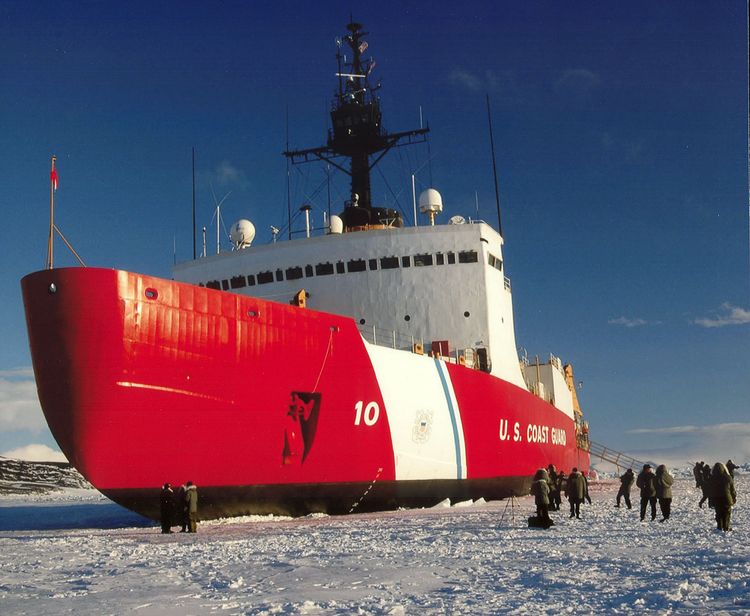
- Hull: Steel “Polar-class” hull with a rounded bow for ice-diving; massive plating and internal framing for extreme cold. (Her design once featured ballast tanks to rock the ship free of ice.). The upward angle of Polar Star's bow is designed so that the hull rides up onto the ice surface during icebreaking operations. Subsequently, the ship's weight and forward motion combine to fracture the ice.
- Crew and Scientists: Cruises with roughly 150 personnel (officers, enlisted, and air detachment). Accommodations include heated living spaces, a gym, and a heated navigation bridge over 100 ft above the waterline for improved visibility. There is room for about 30 embarked scientists on research missions.
- Science and Aviation: Can carry up to five containerized labs on deck to support geology, oceanography, meteorology and ice physics research. The flight deck can operate two helicopters at once, which are used for ice reconnaissance, search-and-rescue, and supply runs. (All U.S. polar icebreakers have similar dual-helo decks for these tasks.)
Antarctic Operations (Operation Deep Freeze)
Polar Star has long been America’s “breaker of first resort” for Antarctic logistics. Each November through March she leads the Coast Guard’s role in Operation Deep Freeze, the joint-service effort to resupply McMurdo and South Pole stations. The cutter must forge an ice channel some 20–30 nautical miles long through the Ross Sea each season, allowing fuel tankers and cargo ships to reach McMurdo Station. For example, in 2006 Polar Star cleared nearly 100 miles of ice en route to McMurdo. In late 2025 Polar Star departed Seattle on her 29th Antarctic voyage. After escorting vessels into McMurdo, the crew turned over the station’s supply ship preparations to shore personnel. Capt. Jeff Rasnake commended his team’s dedication: “Polar Star’s crew does remarkable work maintaining and operating this ship,” he said, rising to every challenge on the mission. Until new heavy cutters arrive, Polar Star will continue to be “the only U.S. vessel capable of breaking a navigable channel” to McMurdo – a task its annual deployments have made routine.
Arctic Deployments and Historic Voyages
In the decades before and after Polar Star’s commissioning, U.S. policy also emphasized Arctic science and presence. Polar Star spent many summers in the high North conducting Arctic scientific research cruises. These “Arctic East/West” patrols (often three months long) took her from Alaskan waters across to Greenland, and sometimes as far as Iceland or the Labrador Sea. Onboard were coring winches, geophysical sensors and laboratories to support studies of sub-sea volcanoes, sea ice physics, and marine biology, often in concert with other agencies and universities. The cutter’s 30 scientists would work alongside the crew, using the vessel’s cranes and lab space (five portable labs) to gather samples.
Polar Star’s patrols also made headlines. She was involved in several notable firsts: Polar Star herself circumnavigated Antarctica in 1983 and circumnavigated North America via the Northwest Passage in 1988. (Her sister ship Polar Sea had become the first U.S. surface vessel to traverse the Northwest Passage east–west in 1985.) In 1994 Polar Star and Polar Sea together became the first U.S. surface ships to reach the North Pole. Even in recent years the cutter has pushed boundaries – in January 2022, Polar Star set a record for the southernmost position ever attained by a U.S. ship when she steamed into Antarctica’s Bay of Whales. These feats underscore her dual legacy as both a workhorse of annual resupply missions and a platform for American maritime presence at the poles.
In September 2025 Polar Star returned to Seattle after a 308-day deployment (28th voyage to Antarctica) followed immediately by another dry-dock overhaul. Crewmembers were met by cheering families and friends on the pier, a poignant reminder of the human commitment behind the mission. Maintaining Polar Star over five decades has been challenging: by 2006 the cutter had reached its original design life and was placed in caretaker status awaiting major repairs. When sister ship Polar Sea suffered a catastrophic engine failure in 2010, restoring Polar Star became a top priority. The Coast Guard embarked on a multi-year Service Life Extension Program (SLEP) to recapitalize the ship. Over five annual phases (2021–2025) every major system has been modernized. For example, engineers replaced the 1970s-era main switchboards and 1990s fire-detection system with new digital controls and sensors. Communications, navigation and power systems have been upgraded: in 2023–24 the ship received a new 400‑Hz distribution system for electronics, overhauled gyro repeaters, and refurbished ventilation and heating units to improve onboard habitability. By mid-2025 Polar Star had its three propellers replaced and even a new centerline shaft for propulsion. According to Coast Guard yard manager Kenneth King, completing the SLEP “is a major milestone” that will allow Polar Star “to meet its multifaceted missions in the polar regions until the arrival of the polar security cutter fleet”. Capt. Rasnake similarly observed that “much has been asked of this ship over the past five decades,” and that finishing the five-year overhaul ensures it can sail into the future.
Strategic Importance
Polar Star’s half-century at sea reflects the United States’ changing strategic environment. With climate change opening new sea lanes and resources, the Arctic and Antarctic regions have taken on added importance for national security, commerce and science. U.S. officials now frequently stress that icebreakers are instruments of sovereignty. Polar Star’s missions – from resupply of scientific stations to Arctic patrols – “directly protect the security, freedom, and prosperity” of the United States and its allies in the polar regions. The urgency is underscored by the actions of rivals: Russia today operates more than 40 polar icebreakers and is arming its northern coastline, and even China (a “near-Arctic state” by self-declaration) regularly sends ships into high latitudes. Only in the past few years has Washington begun matching that with domestic assets. The 2025 budget legislation provides unprecedented funding: for example, $4.3 billion was approved for three new Polar Security Cutters, and $3.5 billion for dozens of new medium and light icebreakers (including a deal to buy 11 vessels from Finland). As one commentator put it, “this frozen frontier, once patrolled by a single aging ship, will soon host a fleet befitting American strategic interests at both poles”.
For now, the Polar Star itself embodies the U.S. commitment in the cold. Day by day, through decades of wear and repairs, she has kept the U.S. flag flying in regions where few others can venture. In 50 years of service she has seen the Coast Guard’s icebreaking fleet dwindle to a lone ship and now set new records – yet her mission has hardly wavered. Whether clearing ice for a fuel tanker to McMurdo Station or deploying scientists amid Arctic floes, USCGC Polar Star continues to safeguard America’s national interests at the ends of the Earth.
Future Plans and Replacement
Even as Polar Star sails on, the Coast Guard is already building its next-generation icebreakers. In 2022–2025 Congress funded a sweeping high-latitude shipbuilding initiative: roughly $9 billion was allocated for new icebreaker construction, the largest polar investment in U.S. Coast Guard history. Under this program, three new Polar Security Cutters (each about 460 ft long and 24,000 tons) will replace the aging heavy-breaker fleet. These ships – the first of which is expected around 2030 – are being designed with even greater ice power, modern command-and-control systems, and (for the first time) defensive weapons to assert U.S. interests in polar waters. Parallel plans include an Arctic Security Cutter program (smaller, medium-class icebreakers); notably, in 2024 the Coast Guard bought the former ice-capable tanker Aiviq and renamed her USCGC Storis (WAGB-21) to augment capability immediately.
Until the new cutters arrive, Polar Star will remain essential. “Polar Star is the Coast Guard’s only active heavy polar icebreaker,” the service notes, and it is investing in a new fleet to carry on the mission. Thanks to its recent overhauls, Polar Star is expected to serve into the 2030s – well past age 55 – to cover the gap. In practical terms, that means this single ship will continue breaking the ice for America’s polar program each year until her successors are fully operational. Its continued service hinges on diligent maintenance and careful scheduling; crews jokingly refer to Polar Star as the U.S. Coast Guard’s “Grandmother,” venerable but indispensible.
Track Polar Star at Voyage Radar: https://aisvesseltracker.com/?mmsi=367255000