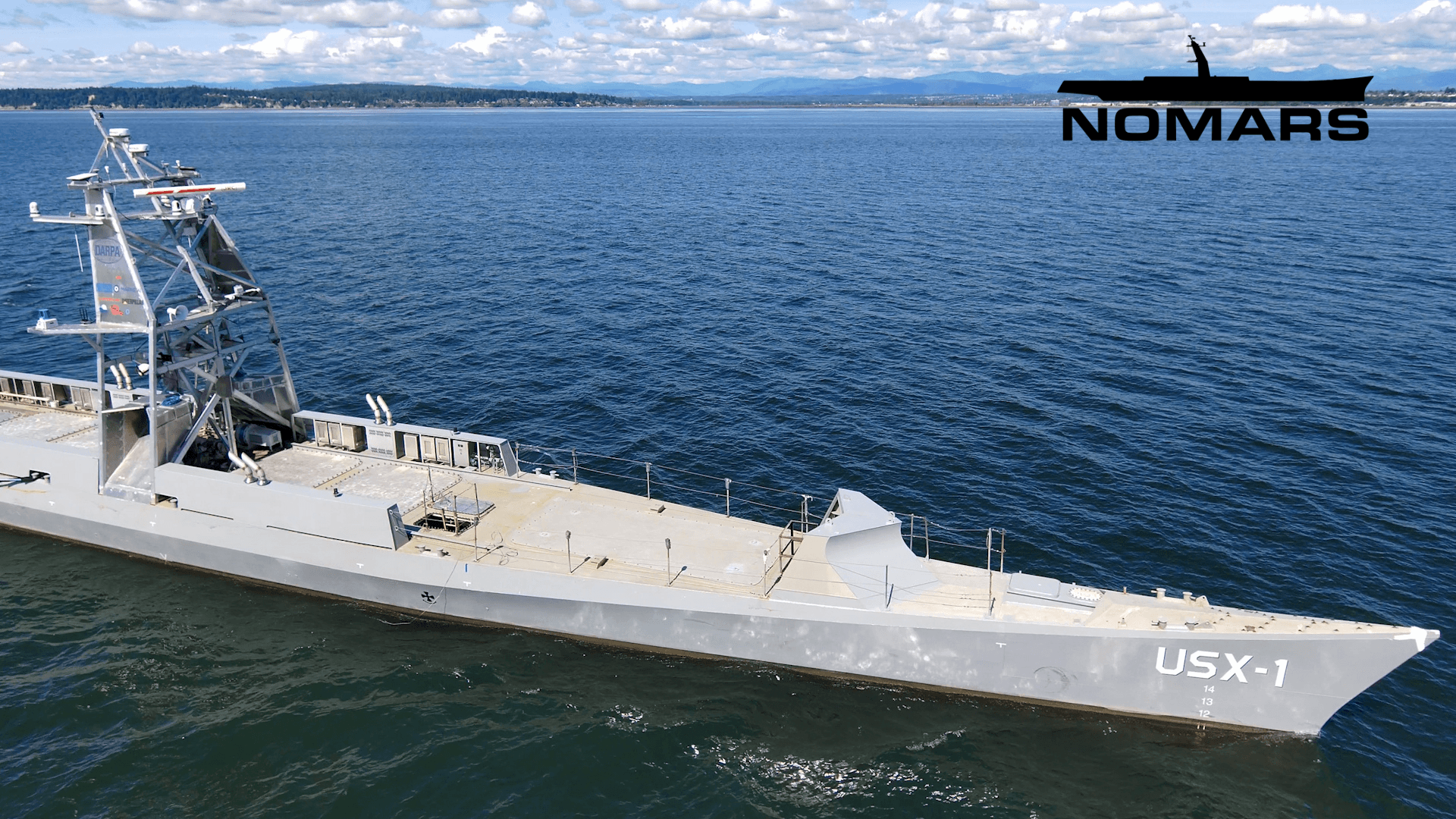
The concept that DARPA's No Manning Required Ship (NOMARS) program is advancing is a bold one: designing and building ships from the keel up to operate without any crew on board. The demonstration vessel for this concept is the USX-1 Defiant, a 180-foot (55 m) medium unmanned surface vessel (MUSV) that weighs in at 240 metric tons. By eliminating crew comforts and crew accommodations, NOMARS is aiming to achieve substantial improvements in efficiency, cost-effectiveness, and reliability. The concept that DARPA is advancing is a clean-sheet approach to designing a smaller and faster vessel that is also lighter and has fewer mechanical components. The result is better hydrodynamics, longer endurance, and better stealth and survivability in heavy seas or combat. The vision for the future that DARPA is advancing is one of quickly and efficiently manufacturing these vessels to project naval presence around the world. The concept is one that policymakers and military leaders are on board with. The benefits that policymakers believe will be realized by employing unmanned vessels include sailors staying out of harm's way and increasing the number of vessels that can be fielded for a fraction of the cost. To this end, Congress has already allocated $2.1 billion for medium unmanned surface vessels.
Smaller, Cheaper Hull: Without the need for crew spaces (no bridge, no galleys, no bunks, etc.), the Defiant's hull can be made narrower and lighter for the same payload capacity.
Long Endurance and Reliability: The Defiant is designed with automation in mind, allowing it to stay at sea for up to one year without human maintenance. DARPA is aiming for 90% system uptime at sea during the course of one year.
Stealth and Survivability: The Defiant's design, with fewer openings and its "dagger-like" hull shape, will have a much lower radar and thermal cross-section than traditional ships. Additionally, the Defiant's design will make it more resistant to the weather, with the ability to safely operate in 13-foot waves (Sea State 5) and withstand up to 30-foot waves (Sea State 7).
Distributed Fleet Potential: The Defiant's design is relatively simple, which will allow many of these vessels to be constructed by smaller shipyards. The idea is that the "fleet" of Defiant-class vessels will support manned warships in surveillance, logistics, etc. roles.
These are the advantages of this new approach, and this is why DARPA initiated the NOMARS project in 2020. The initiative seeks to show that, contrary to the traditional "build around a crew" approach, autonomous warships are possible and are perceived as essential by warfighters.
Design of the USX-1 Defiant
The USX-1 Defiant is unlike any other vessel. It is 180 feet long and weighs 529,000 pounds (240 metric tons) empty. However, it has no crew. The ship is very slender, with an aspect ratio of 10:1 (length to beam). This gives it a "dagger-like" profile that cuts efficiently through waves. There is no bridge area or human accommodations of any kind. Instead, there is a tall, narrow superstructure that holds sensors, controls, and autonomous navigation equipment. The rest of the ship is dedicated to fuel tanks, generators, batteries, and module space. The Defiant is “no wider than it needs to be to carry the largest piece of hardware.” There are no hallways, bunks, or ventilation systems to accommodate.
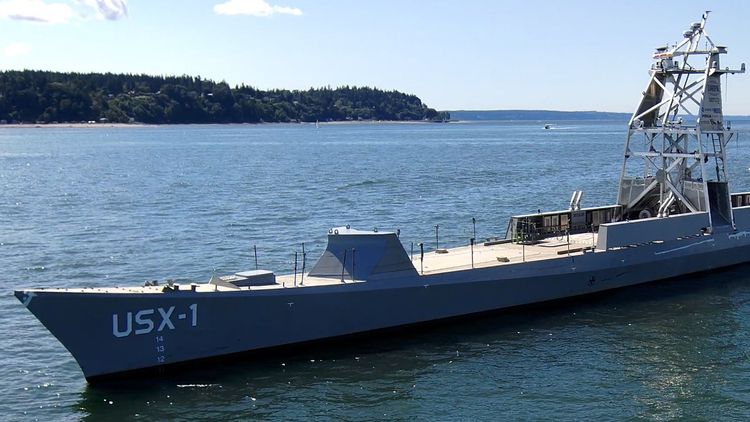
This clean design results in a flat open deck that can accommodate mission modules. For example, DARPA’s models show the Defiant with a container on the deck. This container can hold additional fuel, sensors, and even a BAE Systems Adaptable Deck Launcher for missiles. (In concept art for larger future USVs that will operate in the Navy, up to four of these launchers and 16 missiles are contemplated.) The Defiant does not have crew on board but still carries standard navigation equipment. The mast on the Defiant carries commercial marine radar, satellite antennae, and optical sensors to detect other vessels and obstacles. The Defiant's propulsion and machinery are all provided by commercial suppliers. The Caterpillar company provides the diesel generator sets. The electric motors for the Defiant are provided by Leonardo DRS. The motors are powered by offshore-style thrusters provided by Thrustmaster. The use of commercial components packaged in "plug-in" ISO modules ensures that if one engine or generator ever fails, it can be replaced in as little as 16 hours. The use of these components also ensures that the Defiant can operate even if some of the components fail. The ship can simply bypass a failed component and continue on its way. This is referred to as a "graceful degradation." The Defiant will still be able to operate at 15 knots even after a year at sea and some degradation of some of the components.
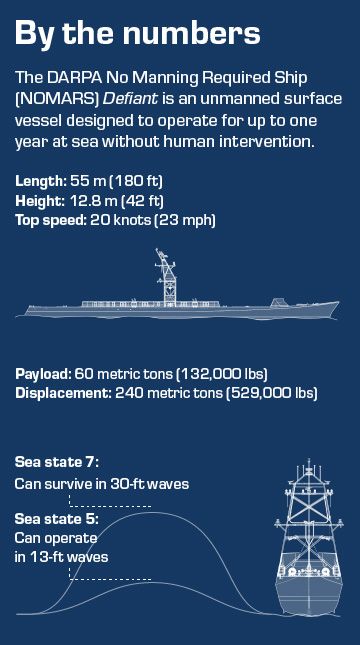
Specificaions: The vessel is 180 ft or 55 m long and the height of the vessel is 42 ft or 12.8 m. The vessel’s 240 tons displacement and streamlined body enable it to reach a speed of 20 knots or 37 km/h. The hydrodynamics and fuel capacity of the vessel enable it to sail for a year or more without refueling. The vessel can withstand 30 ft high Sea State 7 and can sail through 13 ft high Sea State 5 waves. The payload deck of the vessel can carry 60 metric tons of equipment, which can be used for the vessel’s missions. The vessel represents the extreme of simplicity since it does not require crew and only requires space and equipment for the vessel’s missions, which can deliver more for less, as stated by the Defense Advanced Research Projects Agency (DARPA).
Building and Testing Defiant
USX-1 Defiant was constructed under contract from DARPA, which was awarded to Serco Inc. (previously Serco North America) in 2022. Serco designed and integrated the vessel, while the hull was constructed by Nichols Brothers Boat Builders in Freeland, Washington. Nichols Brothers is a small 'Tier III' shipyard, which demonstrates the advantage of using simple construction methods. Serco won the contract against competitors such as Leidos/Gibbs & Cox. The construction of the Defiant was designed with manufacturability in mind; its systems are constructed from readily available components and assembled like a modular product, which means that future construction could be undertaken in many different places.
Construction of Defiant was completed in February 2025, after which the vessel was launched in March 2025 for integration and testing. Prior to this, in January 2025, DARPA had successfully demonstrated autonomous in-sea refueling operations with the help of two unmanned surface vessels, Ranger and Mariner, which proved the capability of vessels like Defiant to conduct autonomous refueling operations in the future.
Between April and June 2025, several tests were conducted on Defiant. The tests included dockside tests and harbor tests. During this period, the vessel’s navigation, communication, and autonomous capabilities were tested.
On August 11, 2025, Defiant was christened in Everett Ship Repair in Washington State. The christening of Defiant marked the first time that the US Navy had commissioned a vessel that would operate without any human intervention.
In September 2025, the vessel concluded its long-haul sea tests. During this period, the vessel traveled over 1,100 nautical miles to Port Hueneme in California from Puget Sound. The vessel tested its capabilities in high-speed maneuvers, autonomous docking, and refueling. The tests were conducted in the presence of naval personnel.
After the successful completion of tests in late 2025, DARPA plans to transfer Defiant to the US Navy’s unmanned maritime systems program office in 2026. The vessel is set to become the first fully autonomous medium USV.
Since its development, Defiant has been hailed as a 'first of its kind' shipbuilding technology that represents a significant leap forward in unmanned shipbuilding. According to Serco's project manager Ryan Maatta, speaking to naval media sources, Defiant will undergo two months of sea trials prior to an even longer demonstration with 90% reliability and refueling of the ship without human intervention being critical requirements. Gregory Avicola, DARPA's NOMARS program manager, has hailed Defiant as a 'tough little ship' that challenges conventional limits - such as continuing to operate in storms and resuming operations after them – made possible by the fact that "we have no human passageways to worry about".
Comparison to Manned Ships and Other USVs
USX-1 Defiant is unique compared to both conventional crewed ships and other unmanned designs. Unlike any manned warship of comparable size (about that of a small corvette or tug), it has no crew, so it does not require any life support or habitability systems. This is a revolutionary change, as most combatant ships (destroyers, frigates, even corvettes) have entire decks dedicated to internal space for crew. In contrast, the designers of Defiant stripped out all the things that would be needed for human crew members - no bridges, stairways, galleys, or bunks. As one account says, "The only things Defiant has in common with a conventional ship are its engines and its shape. Even the control room is smaller and automated."
The result is that almost 30% of a similar-sized crewed ship would typically be spaces and equipment that Defiant just ignores. This means that Defiant’s payload fraction is much higher – more of its volume is dedicated to fuel, batteries, sensors, or weapons. Admiral (Ret.) William Owens, who once stated that ships with sailors "eat up a lot of weight and space," has noted that by eliminating berthing and living spaces, Defiant can carry twice as much mission equipment as a crewed ship of similar size.
Defiant is also different from other unmanned ships that have been developed in the past. For instance, the Ghost Fleet Overlord ships were joint high-speed ships that were repurposed to become unmanned ships. However, they were still manned by the Navy during the testing process. Defiant, on the other hand, was designed to be unmanned and was of a much larger size than any other unmanned ship that had been developed in the past. According to Serco's engineers, no one had ever developed an unmanned ship of such a large size before. Defiant is “a much larger form factor” than any other unmanned ship that had been developed in the past.
In sum, Defiant combines the strengths of both worlds: it has the same capabilities as a small combatant in that it can carry heavy sensors and weapons, but it also has the endurance of a patrol boat without the expense of manning. It is more advanced than the current unmanned patrol boats, and more streamlined than a conventional warship. This is the essence of the NOMARS concept.
Challenges and Innovations
The development of a fully autonomous warship is a tough task that requires a set of innovative solutions. For instance, autonomy needs to be almost flawless. Defiant does not have any crew members to keep an eye on it, and its software needs to be able to independently deal with navigation, collision avoidance, and emergency situations. The team employed the latest navigation radar, LiDAR, cameras, and software (thanks to experts such as Submersions Group) to make sure that the ship is able to "see" obstacles and follow sea traffic rules on its own. During the Port Hueneme trials conducted by DARPA, Defiant successfully docked, undocked, and even refueled on its own.
Second, reliability and maintenance. On an manned vessel, some problems can be repaired by the crew, but Defiant has to live with problems and repair them itself. To address this, the team used extreme levels of redundancy and modularity. For instance, Defiant has multiple engines and electronics; if any of these fail, the ship automatically switches to a different one. All of the critical systems are also contained in modular units; if an engine or generator starts to fail, the support team can simply remove it and swap it out for a new one in hours. DARPA terms this "plug-and-play" design, and it’s necessary for an unmanned ship to survive on its own for a year.
Another innovation is the simplified construction process. The hull and installation of Defiant are done through commercial shipbuilding, and there are no complex systems like those found on a navy destroyer. This makes it possible for smaller shipyards (such as Nichols Brothers) to construct or refurbish the ship. As Darpa explained, the ship’s "hull was designed to allow rapid production and maintenance in nearly any port facility or Tier III shipyard." The use of commercial components (such as those from Caterpillar, Leonardo DRS, and so on) and ISO containers also helps to keep the costs low. This is a new approach to shipbuilding, which is part of “defense innovation” and borrows from cargo ships and tugs.
Finally, the operational concept itself is an innovation. The command and control of an unmanned warship demand secure data links and new naval concepts. During the testing phase, sailors at the Naval Base Ventura County remotely controlled Defiant's operations, gathering data. In a real-world scenario, a fleet of these ships would demand ground controllers or afloat controllers, and a backup system in the form of manual control, to be integrated into fleet command. These issues are being addressed by the teams involved.
In conclusion, USX-1 Defiant represents numerous firsts - from unmanned navigation and refueling to modular naval design. As Greg Avicola (NOMARS manager) said, "Swallowing the elephant whole" was needed to complete this DARPA program, meaning that all these difficult issues had to be addressed at once. While each of these represents a difficult problem, they all had to be solved to enable the existence of an unmanned warship.
Outlook
The USX-1 Defiant project is more than just an experiment; it is actually laying the groundwork for future generations of naval fleets. Once the Defiant has completed its demonstrations, it will assist the U.S. Navy in proving its doctrine regarding fully autonomous naval vessels. What is learned from the Defiant’s long-range voyages and experiments will go towards the development of new generations of unmanned naval vessels, possibly even armed ones. It is widely expected by many military analysts that by the 2030s, a "hybrid" fleet of manned and unmanned vessels will become the norm, and the Defiant is the prototype for this.
Whether it is in a competition against other navies or in peacekeeping missions, ships such as Defiant are set to multiply the power of the American navy. Since they are crewless, they can last longer, be less expensive per mission, and be deployed into danger zones without putting lives at risk. According to DARPA, "Defiant protects and multiplies the capabilities of manned ships at low cost." As testing continues, the USX-1 Defiant will prove how a crewless warship can change the rules of the sea.