Summary:
USS Thresher (SSN‑593) was the lead submarine of the Permit class (originally named Thresher class), built at Portsmouth Naval Shipyard, Kittery, Maine. Laid down in 1958 and commissioned in August 1961, Thresher embodied major Cold War innovations – a teardrop hull, HY‑80 high-strength steel, advanced sonar and weapons (including SUBROC). In April 1963, during deep-diving trials 220 miles east of Cape Cod, Thresher suddenly began sinking. Its last messages ("minor difficulties… attempting to blow", then silence) and hydrophone records indicate a rapid, uncontrolled dive. The Court of Inquiry (1963) concluded that flooding in the engine room – likely from ruptured brazed joints in a sea-water piping circuit – was the probable trigger. The flooding led to electrical shorts, a reactor scram and loss of propulsion; a final "main blow" to surface failed (air lines froze), so the boat descended past crush depth and imploded. No crew survived (129 officers, men, and civilian shipyard technicians). The Navy’s exhaustive search (surface ships, Trieste bathyscaphe) confirmed the wreck at 8,400–8,500 ft depth.
The Thresher tragedy was a catalyst for sweeping submarine safety reforms. In June 1963 the SUBSAFE program was created to ensure critical systems (hull integrity, emergency blow, etc.) meet rigorous standards. Since SUBSAFE’s inception, no SUBSAFE-certified submarine has been lost. USS Scorpion (SSN‑589) sank in 1968 with 99 men, but as a non‑SUBSAFE boat, and its loss spurred further safety scrutiny. Thresher’s legacy endures in memorials and lessons learned: annual ceremonies (e.g. Portsmouth and Kittery) honor the 129 lost, and Thresher became synonymous with a new culture of submarine safety. Retired submariners and historians continue to analyze the accident (some citing SOSUS acoustic data suggesting a hull collapse) and stress that Thresher’s lessons – from welding quality to crew training – remain vital.
Construction and Design:
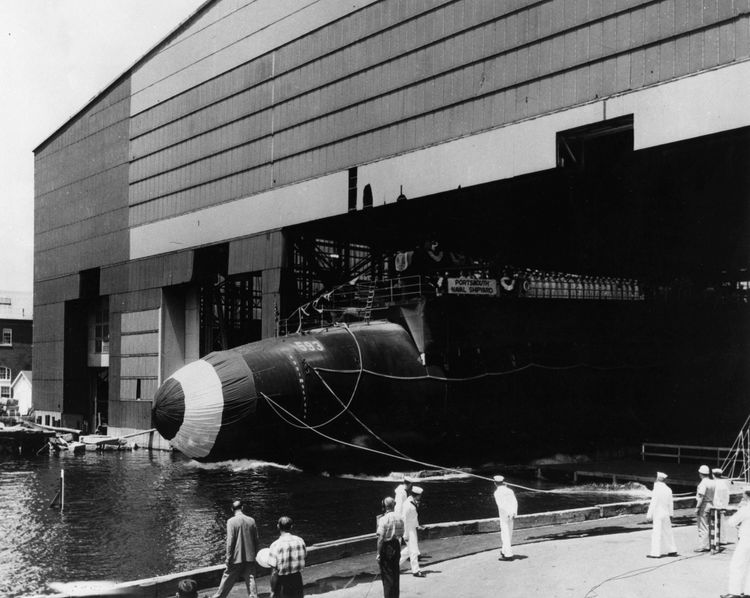
USS Thresher was laid down on 28 May 1958 at Portsmouth Naval Shipyard, Kittery, Maine (contract awarded 15 Jan 1958). She was launched on 9 July 1960 and commissioned 3 August 1961 under Cmdr. Dean W. Axene. As lead of her class, Thresher embodied cutting-edge design. Compared to the preceding Skipjack‑class, Thresher had 22% greater displacement and a beam 2 feet wider, to accommodate new systems. Her teardrop-shaped hull (modeled on the Albacore) was made of HY-80 steel (yield strength 80,000 psi), enabling a test depth around 1,300 feet, roughly double the 700‑ft test depth of earlier nuclear submarines. Advanced sound-damping measures (rubber mounts, machinery isolation) made Thresher very quiet for its era. In the bow it carried a large spherical sonar (AN/BQQ-2), forcing its torpedo tubes amidships – a novel arrangement. Armament included four 21-inch (533 mm) torpedo tubes (capable of firing Mk 37 torpedoes and the new SUBROC missile), plus mine-laying capability. She was powered by a single Westinghouse S5W nuclear reactor driving turbines (~15,000 shp) for about 33 knots submerged. Her overall dimensions and displacement were: length 279 ft, beam 32 ft, draft 26 ft, displacement about 3,540 long tons (surface) and 3,770 tons submerged. (Crew: 16 officers and 96 enlisted.) In sum, Thresher was arguably the fastest, deepest-diving attack sub of its time.
Service History:
After commissioning, Thresher spent a year in shakedown trials and training (1961–62) in the western Atlantic and Caribbean. Early in her career she excelled in acoustic and weapons tests, proving exceptionally quiet. For example, in 1961 she participated in Nuclear Submarine Exercises off the U.S. East Coast to hone anti-submarine tactics. In late 1961 she steamed to Puerto Rico (with diesel sub Cavalla) for exercise trials; during a port call at San Juan, poor pier facilities forced reliance on her diesel generator, which later failed. Crew worked by flashlight in 140°F heat to restart the nuclear reactor, eventually aided by power cabled from Cavalla. In 1962 Thresher continued testing: sound trials in the Bahamas confirmed her quietness, and she supported development of the new SUBROC missile off Charleston and Florida. While moored at Port Canaveral, Florida (late 1962), she was accidentally struck by a tug, damaging a ballast tank. Repairs were made at Electric Boat in Groton, Connecticut, and Thresher resumed trials off Key West. On 16 July 1962 she entered Portsmouth Naval Shipyard for a post-shakedown availability (originally 6 months, ultimately extended to ~9 months). The yard period (Jul 1962–Apr 1963) allowed inspection and correction of dozens of defects from construction and testing. Thresher was finally recertified and undocked on 8 April 1963.
Loss of USS Thresher (April 1963):
Final Cruise:
On 9 April 1963 Thresher departed Kittery, Maine (New Hampshire), at 0800 under LCDR John W. "Jack" Harvey, with USS Skylark (ASR-20) acting as rescue escort. They rendezvoused at 1100 and steamed to a deep-diving test area about 220 miles east of Cape Cod. That afternoon Thresher performed a shallow trim dive, surfaced, then made a second dive to about 650 feet (half of her 1,300-ft test depth). The submarine remained submerged overnight. Early 10 April 1963, Thresher and Skylark resumed test dive operations. Following standard procedure, Thresher made slow, staged descents and paused every 100 ft to check systems integrity. Just past 1300 ft, at approximately 0917, Skylark heard a garbled underwater telephone message from Thresher: "…minor difficulties, have positive up-angle, attempting to blow." A few moments later a final, even more garbled message included the number "900" (presumably indicating 900 feet). Then all contact ceased. Observers on Skylark heard a sudden sound "like air rushing into an air tank", followed by silence.
Immediate Aftermath:
Skylark attempted to reach Thresher for about an hour, with no response. By mid-morning (10 April) Thresher was officially missing. News of the loss broke by afternoon; that evening Commander Submarine Force Atlantic notified families to prepare for the worst. CNO Admiral George Anderson announced publicly that Thresher was lost with all hands (79 enlisted, 16 officers, and 17 civilian technicians – 112 total onboard; other sources note 129 including some civilian shipyard personnel). President Kennedy ordered flags at half-mast (Apr 12–15). A massive search began at once.
Sequence of Failure (Probable):
Post-accident investigations (Court of Inquiry and later analyses) piece together a likely failure sequence. Within minutes of flooding onset, electrical shorts from seawater spray shut down pumps and the reactor; the boat lost propulsion and began an uncontrolled descent. Meanwhile, the crew attempted an "emergency main blow" of the ballast tanks to surface. However, the high-pressure air system froze at depth (due to moisture and low temperature), blocking the blow valves. With no way to stop the dive, Thresher continued well past her test depth. Naval engineers believe her pressure hull eventually failed (imploded) under hydrostatic pressure (estimated at ~1,400 fathoms, ~8,400 ft). This catastrophic crush was likely what Skylark heard.
The official Court of Inquiry (April 1963) concluded that the probable trigger was flooding in the engine room from a failed pipe joint. Specifically, a silver-brazed seawater pipe (likely 2–5 inch diameter) apparently ruptured under pressure, allowing rapid inrush of water. That led to electrical failures and the reactor scram. The Court found "no one individual or organization" to blame, citing collective faults (workmanship lapses, schedule pressure, etc.). A June 1963 Joint Congressional hearing echoed the Army findings: latent construction defects and quality assurance gaps had set the stage.
Later technical reassessments have debated whether flooding alone explains Thresher’s loss. Retired Capt. James Bryant (whose father was a Thresher victim) and others have analyzed SOSUS acoustic data. These show Thresher may have already passed test depth when she reported difficulties, implying a hull crush could have occurred earlier. Nonetheless, the Navy has consistently stood by the Court’s conclusion: "burst pipe and electrical problems that led to a nuclear reactor shutdown". For families, the "900" message remains a haunting clue that the submarine overran its design limit, but no alternate theory has supplanted the flooding scenario as official wisdom.
Search and Recovery Efforts:
The U.S. Navy launched an immediate and extensive search. By 11 April, submarines Seawolf (SSN-575) and Sea Owl (SS-405) (already in the area) joined, along with surface ships and Naval Research Laboratory (NRL) assets. The NRL deployed the Rockville (small research sub) with towed sonar, and USS James M. Gilliss carried a deep-sea camera. Close-range sonar sweeps by tugs Allegheny, Mission Capistrano, Prevail and others combed a 10×10 nmi area. Most critically, the bathyscaphe Trieste was flown from San Diego and staged in Boston. Trieste conducted two series of dives into the suspected debris field: 24–30 June and late July 1963. On these dives she photographed parts of Thresher’s wreckage on the seafloor. Surface ship Recovery (ARS-43) had already hauled up bits of debris (buoyant items like gloves and insulation). Combined, the evidence was clear: Thresher had broken apart at about 1,400 fathoms of water, ~220 miles E of Boston. No survivors were found or expected; all hands were presumed lost. The Navy publicly acknowledged final defeat of the search by late June 1963.

The wreck itself lies in ~8,400–8,500 ft of ocean (about 130 miles east of Cape Cod). Its debris is scattered over roughly a one-mile area. (At this depth, any attempt at salvage or rescue was impractical with 1963 technology – indeed, the Trieste operations marked the first "observation" of a sunken nuclear sub.)
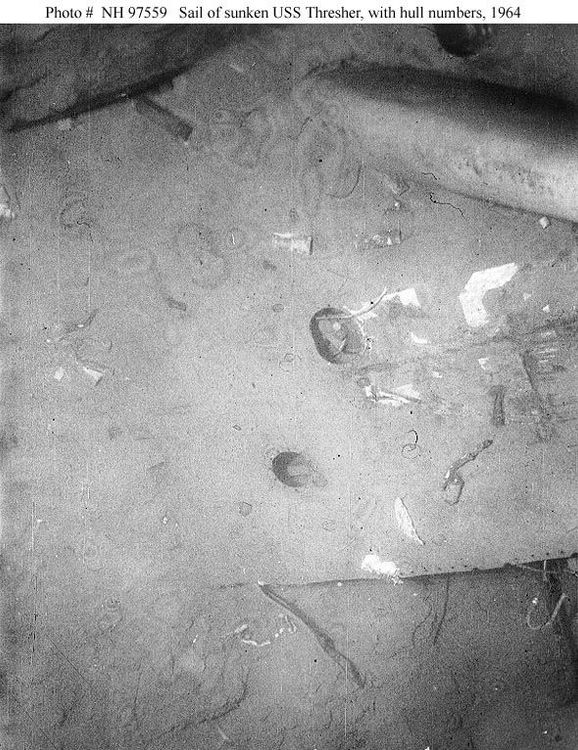
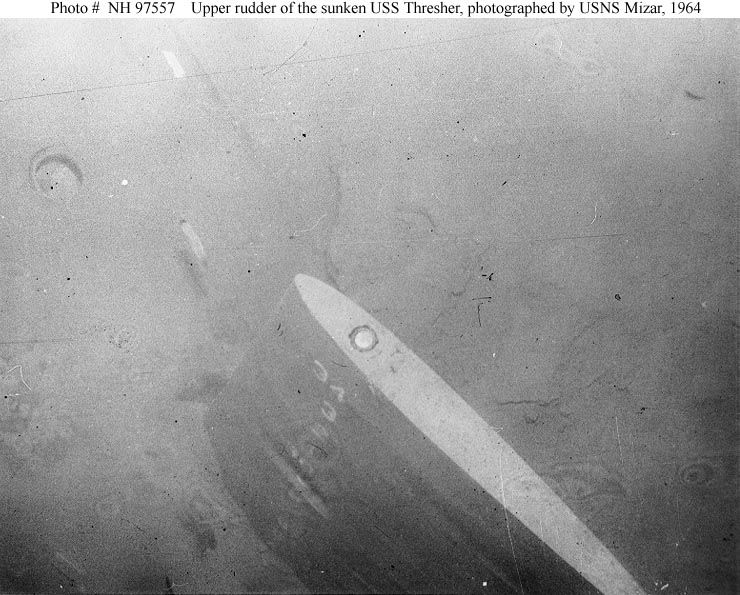
Find more images of the Wreck of USS Thresher at: https://ibiblio.org/hyperwar/OnlineLibrary/photos/sh-usn/usnsh-t/ssn593-l.htm
Submarine Safety Reforms: SUBSAFE and Beyond:
The Thresher disaster sent shockwaves through the Navy. A direct outcome was the creation of SUBSAFE on 3 June 1963. SUBSAFE instituted an exacting safety certification for all critical systems affecting buoyancy and hull integrity. Submarines and production yards were retrained: designs were strengthened, welds and joints strictly inspected, and emergency systems (blow valves, air dryers, etc.) overhauled. The goal was "maximum reasonable assurance of hull integrity… and the operability and integrity of critical systems… to recover from a flooding casualty". By December 1963, Naval Sea Systems Command had formalized these requirements ship-by-ship, creating rigorous records and testing for valves, piping, and equipment.
The effect was profound: only one submarine has sunk since (USS Scorpion in 1968), and she was not SUBSAFE-certified. The Navy often notes that "we have never lost a SUBSAFE-certified submarine". It credits SUBSAFE with turning Thresher’s tragedy into a case study that has kept the U.S. submarine force exceptionally safe for decades. (As CAPT Bryant observes, though Thresher’s details remain partly classified, the reforms it spawned – improved piping techniques, better test and simulation, emergency blow redesign, etc. – are an enduring legacy.)
Human Stories and Memorials:
On April 10, 1963, 129 officers, crew, and civilian shipyard personnel perished with Thresher. The loss devastated families and the submarine community. Notably, twelve graduates of the U.S. Naval Academy (Classes of 1944–1959) were among those lost. Today, families and veterans keep their memory alive in numerous ways. Annual memorial services occur each April at locations such as Portsmouth Naval Shipyard (where Thresher was built) and Traip Academy in Kittery, Maine. For example, on 10 April 2025 the Thresher Base of the US Submarine Veterans (USSVI) held its 62nd annual ceremony, with wreath-layings and keynote speeches. Speakers often include relatives; at the 2025 Kittery service, Michael Bracey (son of Steward 3/c George Bracey lost on Thresher) shared personal photos and recalled never having known his father. Portsmouth Naval Shipyard’s commanding officer remarked that by "more than six decades" the community’s support and remembrance remain "amazing and heartwarming".
Families have also expressed solace in positive outcomes. For example, Tim Noonis (whose father Lt. JG William Noonis was the radio operator on Thresher) told reporters in 2021 that although "the loss remains painful," he takes comfort that the Navy learned from the tragedy to protect future sailors. He noted, "No one wants to lose a family member, but if other families have benefited… there’s some solace in that". The Navy’s collective message is "We will never forget," echoed in plaques and the chorus at memorials.
A variety of memorials honor Thresher’s crew. At the entrance to Portsmouth Naval Shipyard stands a plaque dedicated to Thresher and her men. The US Submarine Veterans organization designated April 10 as "Thresher Day," lit shipyard beacons and tolling bells nationwide. In Groton, Connecticut (homeport of many crew), a "Circle of Heroes" memorial wall lists the names. Online and print tributes – from naval histories to memorial websites (e.g. On Eternal Patrol, USS Thresher Memorial) – ensure that each of the 129 is named and remembered.
Controversies and Alternate Theories:
For decades, some of the crews' families and veterans have questioned aspects of the investigation. Most call for full declassification of Thresher's records. (In 2020–21, the Navy released additional Court of Inquiry testimony.) Critics like Capt. Bryant (ret.) argue that the official scenario may overlook a sudden hull implosion triggered by depth, citing acoustic data. Proponents of this "hull collapse" theory note the submarine’s final communications and SOSUS recordings hint the dive exceeded design limits. Others point to earlier shock trials: some aircraft dropped near Thresher in October 1962 may have loosened equipment or pipes, creating the flooding vulnerability.
Nonetheless, most historians accept the consensus that Thresher’s core problem was flooding. A 2021 Associated Press report (based on newly released documents) quoted Navy experts: the cause was "likely" the burst piping and resultant reactor shutdown. The AP article stressed there was "no coverup" – rather, a rapid tempo of submarine development during the Cold War outpaced procedures. It noted known vulnerabilities (brazed joints, untested deep-blow system) and training gaps, but concluded the documents "show the Navy’s policies and procedures failed to keep pace" rather than a conspiracy.
In sum, debates about Thresher continue among experts: Was a single piping failure sufficient to sink her, or did multiple factors align? Would a fully-flooded electrical trunk alone slam her below crush depth? The Court of Inquiry and Navy stand by the flooding scenario, but some at naval historical foundations advocate further study of the acoustic evidence. No official revisions have been made. Whatever the nuances, the broad lessons – meticulous quality control, robust emergency systems and thorough testing – remain undisputed.
Legacy:
USS Thresher's enduring legacy lies in lessons and reforms rather than a preserved hull. Technically, her loss led to better standards: all modern U.S. subs are SUBSAFE-certified, undergo comprehensive sea trials, and are built under intense oversight. USNI Proceedings and Navy literature often highlight Thresher as the tragic impetus for a "new safety era". In the Cold War context, Thresher’s sinking was America’s worst peacetime sub disaster; in 2023 the National Archives called her "a modern submarine on eternal patrol," marking 60 years of remembrance.
Culturally, Thresher appears in books, documentaries, and journalism as a case study in naval engineering and crisis. (For example, James Bryant’s 2018 USNI Proceedings essay "Declassify the Thresher Data" and an Associated Press retrospective in 2021.) Memorial services keep her story alive. Portsmouth Naval Shipyard holds annual wreath-laying (Project Port Way’s "Thresher Memorial" service), and USSVI posts monthly reminders. The phrase "We will never forget" has become emblematic at these events. In the end, Thresher taught the Navy that even "the most advanced submarine" must be honored with utmost caution – and that the memories of her crew fuel commitment to safety.
Timeline of Key Events (USS Thresher):
Date: 15 Jan 1958 Event: Contract awarded to Portsmouth Naval Shipyard (Kittery, ME)
Date: 28 May 1958 Event: Keel laid at Portsmouth Naval Shipyard
Date: 9 Jul 1960 Event: Launched (sponsored by Mrs. F. Warder)
Date: 3 Aug 1961 Event: Commissioned (Cmdr. Dean L. Axene in command)
Date: 18–24 Sep 1961 Event: Participated in NUSUBEX 3-61 exercises off NE U.S. coast
Date: Oct–Nov 1961 Event: Shakedown cruise to Puerto Rico (San Juan port call)
Date: 29 Nov 1961 Event: Returned to Portsmouth Naval Shipyard
Date: Mar 1962 Event: ASW exercises (NUSUBEX 2-62, Task Group ALPHA)
Date: Apr 1962 Event: Participated in naval weapons tests off Charleston, FL
Date: 7 Nov 1962 Event: Struck by tug at Port Canaveral; ballast tank damage (repaired)
Date: 16 Jul 1962 Event: Entered Portsmouth NSY for post-shakedown availability (PSA)
Date: 8 Apr 1963 Event: Undocked (PSA complete)
Date: 9 Apr 1963 Event: Departed Kittery, ME with escort USS Skylark for deep-dive trials
Date: 10 Apr 1963 Event: Lost during final deep-dive: last message “minor difficulties, attempting to blow”; 129 souls lost (100% of crew)
Date: 11–15 Apr 1963 Event: Search operations by U.S. Navy (surface ships, subs Seawolf, Sea Owl, NRL)
Date: 24–30 Jun 1963 Event: Bathyscaphe Trieste dives on debris field; confirms submarine broke up in ~1,400 fathoms
Date: 3 Jun 1963 Event: U.S. Navy establishes SUBSAFE safety program (in response to Thresher loss)
Date: Apr 10 (Annually) Event: Memorial services (USSVI Thresher Base ceremonies, wreath-layings)